Physical Address
5206 Hwy 5 N Suite 100, Bryant, AR, United States, Arkansas
Physical Address
5206 Hwy 5 N Suite 100, Bryant, AR, United States, Arkansas

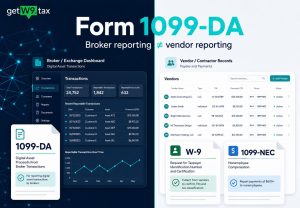
Digital-asset tax reporting changed significantly beginning with transactions made in 2025. Brokers now use Form 1099-DA, Digital Asset Proceeds From Broker Transactions, to report certain sales and dispositions of cryptocurrency and other digital assets.
However, Form 1099-DA does not replace Form W-9, Form 1099-NEC, or the normal rules for paying contractors and vendors.
That distinction matters. A crypto exchange may report a digital-asset disposition on Form 1099-DA, while a business paying a contractor in crypto may separately have vendor-information and nonemployee-compensation reporting responsibilities.
Form 1099-DA is generally filed by a digital-asset broker—not by every business that accepts or uses cryptocurrency.
For transactions occurring in 2025, brokers generally report gross proceeds. Beginning with transactions occurring in 2026, brokers must also report basis information for certain covered digital assets.
A business that pays a contractor or vendor in crypto may still need to collect the appropriate tax documentation and comply with the ordinary information-reporting rules. For a U.S. payee, that documentation will often be Form W-9. Foreign payees generally provide an appropriate Form W-8 instead.
For federal tax purposes, a digital asset is a digital representation of value recorded on a cryptographically secured distributed ledger, such as a blockchain or similar technology.
Examples can include:
The IRS generally treats digital assets as property, not as U.S. currency. Selling, exchanging, spending or otherwise disposing of a digital asset can therefore create a reportable transaction and a taxable gain or loss.
Form 1099-DA is an IRS information return officially titled Digital Asset Proceeds From Broker Transactions.
It is used by covered brokers to report certain sales, exchanges and other dispositions of digital assets that they effect for customers.
It is similar in purpose to Form 1099-B, which is commonly used by traditional brokers to report securities transactions. Form 1099-DA is specifically designed for digital assets.
A Form 1099-DA may include information such as:
Form 1099-DA is an information return. It does not necessarily calculate the recipient’s final taxable gain or loss.
Form 1099-DA is generally filed by a U.S. digital-asset broker that effects reportable digital-asset sales for customers.
Depending on its activities, a broker may include:
Simply accepting crypto from a customer or paying a vendor in crypto does not automatically turn an ordinary business into a Form 1099-DA broker. The business must examine what services it actually provides and whether it effects digital-asset sales for other people.
The Form 1099-DA rollout occurs in stages.
For reportable digital-asset sales effected in 2025, brokers generally must report gross proceeds.
Brokers were not required to report cost basis for those 2025 transactions, although voluntary basis reporting was permitted.
This means a Form 1099-DA covering a 2025 transaction may show what the customer received from the sale without showing what the customer originally paid for the digital asset. The recipient must therefore maintain separate cost-basis records to calculate the actual gain or loss.
For transactions occurring after 2025, brokers generally must report:
Basis reporting is generally voluntary for noncovered digital assets. Certain optional reporting methods for qualifying stablecoins and specified NFTs may also allow brokers to omit basis and other transaction-level information.
A digital asset is not automatically a covered security simply because it was purchased in 2026.
In general, a digital asset is covered when it:
A digital asset is generally noncovered when it was:
This distinction determines whether the broker must report basis information.
Usually, no.
Paying a contractor in crypto does not automatically require the business to prepare Form 1099-DA. Form 1099-DA is generally the broker’s reporting form.
However, paying for services with digital assets can create two separate tax and reporting issues.
The fair market value of the digital assets received for services is generally income to the contractor.
Depending on the payment, the payee and the applicable reporting rules, the business may still need to report nonemployee compensation or another type of payment on Form 1099-NEC or Form 1099-MISC.
Using crypto instead of dollars does not automatically remove the normal information-reporting requirements.
When a business transfers digital assets in exchange for services, it may also be disposing of property.
The business may therefore need to calculate a gain or loss based on:
A broker involved in the transaction may separately report the disposition on Form 1099-DA.
These forms have different jobs.
| Form | Main purpose | Usually handled by |
|---|---|---|
| Form 1099-DA | Reports certain digital-asset sales and dispositions | Digital-asset broker |
| Form W-9 | Collects a U.S. payee’s legal name, tax classification and TIN | Business, payer or broker requesting the information |
| Form 1099-NEC | Reports qualifying nonemployee compensation | Business or payer |
| Form 1099-MISC | Reports certain other payments, such as rents or royalties | Business or payer |
| Form W-8 | Documents the status of an applicable foreign payee | Foreign individual or entity |
Form W-9 is generally retained by the requester. It is not normally submitted directly to the IRS by the person completing it.
The information collected on Form W-9 can later support applicable information returns, including Forms 1099-NEC and 1099-MISC. Brokers may also request taxpayer information from customers to meet Form 1099-DA reporting requirements.
A business should not collect Form W-9 from everyone it pays without considering the payee’s status.
Form W-9 is generally used by a U.S. person, including a U.S. citizen, resident alien or qualifying U.S. entity, to provide a correct taxpayer identification number.
A foreign person should generally not complete Form W-9. The person may instead need to provide the applicable Form W-8 or, in certain cases, Form 8233.
For applicable U.S. vendors and contractors, collecting Form W-9 before payment helps the business:
The W-9 supports the vendor-payment record. It does not determine whether the business is a Form 1099-DA broker.
The general tax rules allow backup withholding to apply to certain reportable payments when a payee does not provide a correct or properly certified TIN.
However, the IRS provided transitional relief specifically for broker-effected digital-asset sales. Under IRS Notice 2025-33, backup withholding is not required on digital-asset sales effected by brokers during calendar years 2025 or 2026.
This relief is limited to the covered broker transactions. It should not be interpreted as eliminating backup-withholding requirements that may apply to other types of vendor or contractor payments.
Accepting crypto does not automatically mean the business will file or receive Form 1099-DA.
The result depends on how the transaction is structured.
For example, a digital-asset payment processor may act as a broker when it receives digital assets from one party and transfers digital assets, cash or different digital assets to another party. The processor may have Form 1099-DA reporting responsibilities for a reportable disposition that it effects.
The merchant should not assume that Form 1099-DA represents its total business revenue. It should reconcile any form received with its:
The IRS requires taxpayers to keep sufficient records of their digital-asset receipts, sales, exchanges and other dispositions.
Not necessarily. Form 1099-DA is generally filed by a qualifying digital-asset broker that effects reportable customer dispositions.
It does not. A broker-reported digital-asset disposition and a business’s payment to a contractor are separate reporting matters.
Incorrect. Taxpayers must report applicable digital-asset income and transactions even when no information return is received.
Not necessarily. Taxable gain or loss generally depends on the difference between the amount realized and the taxpayer’s adjusted basis, along with other applicable adjustments.
No. Form W-9 is generally for U.S. persons. Foreign payees generally provide the appropriate Form W-8 or other applicable documentation.
Before making or accepting digital-asset payments:
GetW9 does not determine whether a business qualifies as a digital-asset broker, calculate crypto gains or losses, or file Form 1099-DA.
Its role is earlier in the vendor-compliance process.
GetW9 helps businesses request, collect, track and organize W-9 information from applicable U.S. vendors and contractors. That gives accounting and accounts-payable teams a clearer record of which forms have been requested, received or are still outstanding before year-end reporting begins.
Whether payment is made by bank transfer, check or digital asset, clean vendor information remains an important part of preparing accurate information returns.
Form 1099-DA brings more standardized third-party reporting to digital-asset transactions, but it does not replace ordinary vendor documentation and information-reporting rules.
The practical distinction is:
Keep the two reporting tracks separate, maintain complete transaction records and involve a qualified tax professional when determining which forms apply.
Disclaimer: This article is for general educational purposes and does not constitute tax, legal or accounting advice. Digital-asset transactions can have different consequences depending on the parties, transaction structure and applicable law. Consult a qualified professional about your specific situation.