Physical Address
5206 Hwy 5 N Suite 100, Bryant, AR, United States, Arkansas
Physical Address
5206 Hwy 5 N Suite 100, Bryant, AR, United States, Arkansas


Vendor fraud prevention has become a growing priority for finance teams, accounts payable departments, and business owners. Vendor fraud is increasing every year, with scammers using real company names, stolen identities, and AI-generated communications to appear legitimate. While many organizations focus on detecting fraud after it happens, vendor fraud prevention often starts much earlier with accurate W-9 collection and vendor verification during onboarding.
According to the 2025 AFP Payments Fraud and Control Survey, 79% of organizations experienced attempted or actual payment fraud during 2024.
Business Email Compromise (BEC) was the most common attack method, with 63% of respondents identifying it as the leading avenue used by fraudsters.
In a typical BEC attack, a fraudster impersonates:
The attacker then requests payment or asks for bank account information to be updated.
If proper verification procedures are not followed, payments can be redirected to fraudulent accounts.
Vendor impersonation attacks have increased significantly in recent years, and advances in generative AI are making fraudulent communications more convincing than ever.
Fraud prevention is often viewed as a cybersecurity problem.
In reality, it is also a vendor data problem.
When vendor records are incomplete, outdated, or poorly maintained, fraudsters have more opportunities to exploit weaknesses in your process.
Some fraud schemes involve creating entirely fictitious vendors, often called “ghost vendors.”
These fake businesses are added to payment systems and used to generate fraudulent payments.
A W-9 does not prove that a vendor is legitimate.
However, it does create a documented taxpayer identity record that includes:
Requiring this information before issuing payments creates an additional verification step that makes fraudulent vendor creation more difficult.
Payment diversion fraud is one of the most common accounts payable threats.
A fraudster impersonates an existing vendor and requests a change to banking information.
If the change is accepted without verification, future payments may be sent directly to the attacker.
Maintaining accurate vendor records gives finance teams a reliable source of information to compare against.
For example, if a vendor suddenly requests new banking details while all other vendor information remains unchanged, the request may warrant additional review before any payment is released.
A W-9 serves as part of a broader vendor verification process.
The information provided on the form should align with the vendor’s legal business identity.
When vendor information is missing, outdated, or collected inconsistently through email attachments and spreadsheets, the risk of impersonation increases.
Data quality problems often create the conditions that allow fraud attempts to succeed.
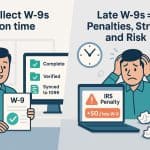
Think of W-9 collection as the front door of your vendor onboarding process.
If vendor information is incomplete or poorly maintained from the beginning, every downstream process becomes more vulnerable.
A strong vendor onboarding process should include:
Every vendor should submit a completed W-9 before receiving payment.
Consistent policies reduce exceptions and improve record quality.
Address validation and data verification help identify incomplete or inaccurate records before they become operational problems.
Vendor tax forms should be stored in a secure, access-controlled system rather than scattered across email inboxes and shared folders.
Maintaining a record of vendor information updates helps organizations identify unusual activity and investigate potential fraud attempts more quickly.
Collecting a W-9 is an important control.
However, it should not be the only control.
Organizations should also consider:
Fraud prevention works best when multiple controls work together.
Vendor fraud continues to increase across organizations of all sizes.
While fraudsters are using more sophisticated techniques, many successful attacks still exploit simple weaknesses in vendor onboarding and vendor data management.
A well-managed W-9 process helps create accurate vendor records, improves visibility into vendor identities, and supports stronger fraud prevention practices.
Ultimately, collecting, maintaining, and securing vendor information is not just about tax compliance.
It is one of the foundational controls that helps businesses reduce risk before money ever leaves the bank account.
Vendor fraud occurs when someone uses deception to obtain unauthorized payments from a business. Common examples include fake vendors, vendor impersonation, and payment diversion scams.
No. A W-9 alone does not prevent fraud. However, it creates a documented vendor identity record that supports verification and helps organizations maintain accurate vendor data.
A W-9 collects a vendor’s legal name, business classification, and Taxpayer Identification Number (TIN). This information can be reviewed as part of a broader vendor verification process.
A payment diversion scam occurs when a fraudster impersonates a legitimate vendor and requests changes to banking information so future payments are sent to the fraudster’s account.
Businesses should use multiple controls, including vendor approval workflows, callback verification procedures, secure document storage, TIN matching, and regular vendor record reviews.
Yes. Incomplete or outdated vendor information can make it easier for fraudsters to impersonate vendors or exploit weaknesses in accounts payable processes.