Physical Address
5206 Hwy 5 N Suite 100, Bryant, AR, United States, Arkansas
Physical Address
5206 Hwy 5 N Suite 100, Bryant, AR, United States, Arkansas

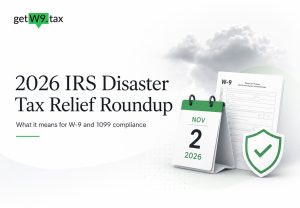
The short version: IRS disaster relief may move some federal tax deadlines. However, it does not automatically move Form 1099 deadlines. A payee gives Form W-9 to the requester, so the form has no IRS filing deadline for the relief to extend.
The 2026 IRS disaster tax relief notices give eligible taxpayers in specific locations more time for certain federal filings, payments and other required actions. However, the relief is limited. It depends on the covered area, the disaster start date and the type of tax action involved.
As of August 4, 2026, the IRS disaster-relief index lists 14 notices for 2026. Several cover disasters that began in late 2025. Therefore, accounts payable teams should not rely on the notice year alone. Most W-2 and 1099-series information returns must still follow their normal deadlines unless official guidance says otherwise.
How to read the table: The date shown is the notice’s headline postponement date. It is not a blanket extension for every return or payment. Instead, an item qualifies only when the taxpayer, location, due date and tax action fall within the notice.
Source: IRS disaster-relief notices indexed for 2026; status reviewed August 4, 2026.
| Notice and area | Disaster began | Headline date | Covered area / status |
| MS-2026-02 Mississippi storms, tornadoes and flooding | May 6, 2026 | Nov. 2, 2026 | Franklin, Lamar, Lawrence, Lincoln and Wilkinson counties |
| WI-2026-02 Wisconsin storms, tornadoes and flooding | Apr. 13, 2026 | Nov. 2, 2026 | 21 designated counties and the Oneida Indian Reservation |
| LA-2026-02 Louisiana – Tropical Storm Arthur | June 17, 2026 | Nov. 2, 2026 | Avoyelles, Lafourche, Pointe Coupee, St. Landry, St. Tammany and Terrebonne parishes (updated July 28) |
| MI-2026-02 Michigan storms, tornadoes and flooding | Apr. 10, 2026 | Nov. 2, 2026 | 37 counties listed in the IRS notice; relief is not statewide |
| NMI-2026-01 Northern Mariana Islands – Super Typhoon Sinlaku | Apr. 11, 2026 | Nov. 2, 2026 | Northern Islands, Rota, Saipan and Tinian |
| MT-2026-04 Crow Tribe of Montana winter storm | Dec. 17-19, 2025 | Sept. 28, 2026 | Crow Reservation |
| MT-2026-03 Fort Peck Tribes winter storm | Dec. 17-18, 2025 | Sept. 28, 2026 | Designated Fort Peck Assiniboine and Sioux Tribes area |
| AZ-2026-01 San Carlos Apache Tribe storms and flooding | Oct. 10-13, 2025 | Sept. 28, 2026 | Designated San Carlos Apache Tribe area |
| GA-2026-03 Southeast Georgia wildfires | Apr. 18, 2026 | Aug. 20, 2026 | Brantley, Clinch and Echols counties |
| HI-2026-01 Hawaii severe storms, flooding and mudslides | Mar. 10, 2026 | Aug. 20, 2026 | Hawaii, Honolulu, Kauai and Maui counties (deadline updated May 12) |
| MS-2026-01 Mississippi severe winter storm | Jan. 23, 2026 | June 8, 2026 | All 82 Mississippi counties; headline deadline has passed |
| TN-2026-01 Tennessee – Winter Storm Fern | Jan. 22, 2026 | June 8, 2026 | All 95 Tennessee counties (updated Apr. 15); headline deadline has passed |
| MT-2026-02 Montana storms and flooding | Dec. 10, 2025 | May 1, 2026 | Blackfeet Indian Reservation, Lincoln County and Sanders County; headline deadline has passed |
| LA-2026-01 Louisiana severe winter ice storms | Jan. 22, 2026 | Mar. 31, 2026 | Statewide; headline deadline has passed |
After FEMA or, in limited cases, a state government issues a qualifying disaster declaration, the IRS may postpone selected federal tax deadlines under Internal Revenue Code section 7508A. Usually, the IRS uses the address on file to identify eligible taxpayers and apply the relief automatically.
However, eligibility can extend beyond people and businesses in the covered area. A taxpayer outside the area may qualify when records needed to meet a deadline are located there. In addition, certain relief workers and people injured or killed while visiting the area may qualify. If the IRS misses an eligible taxpayer, the taxpayer or tax professional may need to contact the agency.
Each notice sets its own relief period. For example, a filing or payment due before that period usually keeps its original deadline. State and local relief also follows separate rules. Therefore, a federal postponement does not prove that a state deadline moved.
Depending on the notice and the due date, IRS disaster relief may cover:
Do not assume April 15 moved: If an income-tax payment was due before the relief period began, that payment usually keeps its original deadline. A later filing deadline may still fall within the relief window.
Most notices do not postpone information returns in the W-2, 1094, 1095, 1097, 1098 and 1099 series. The same limit generally applies to Forms 1042-S, 3921, 3922 and 8027. Likewise, employment and excise-tax deposits usually keep their normal due dates. However, many notices offer a short window to avoid deposit penalties when the taxpayer makes the deposit by the stated date.
Therefore, a business preparing Forms 1099-NEC or 1099-MISC should keep working toward the normal reporting dates. Change that schedule only when the IRS notice or other official guidance clearly covers the required filing.
A U.S. person uses Form W-9, Request for Taxpayer Identification Number and Certification, to give the requester key tax details. These details include the payee’s name, federal tax classification, address and taxpayer identification number. Depending on the taxpayer, the TIN may be an SSN, ITIN, ATIN or EIN.
The payee gives the completed Form W-9 to the requester; neither party sends it to the IRS as a filed return. Businesses usually request the form early in the vendor relationship, ideally before reportable payments begin. As a result, the team has the required data before 1099 preparation starts. Still, no universal rule requires every business to collect the official W-9 before every payment in every situation.
A disaster-relief notice does not refresh the information on an existing W-9. If a payee changes a legal name, TIN or tax classification, the requester may need a new form. Similarly, an updated mailing address can reduce returned mail. USPS address standardization can catch formatting problems, but it cannot confirm that an address is current or guarantee delivery.
A name or TIN issue written on a W-9 does not trigger backup withholding by itself. Often, the IRS spots the mismatch after the payer files an information return. The payer may then need to follow the relevant B-notice and backup-withholding steps.
GetW9 helps businesses send secure digital W-9 requests, collect completed forms online, store the PDF and related details, send automatic reminders and export data for year-end 1099 preparation. Depending on the plan, businesses can also use USPS address validation and a QuickBooks Online integration.
As a result, teams can reduce missing fields, scattered records and manual data entry. However, GetW9 does not replace IRS TIN Matching. It cannot guarantee that a name and TIN match IRS records or that a recipient will receive a 1099. Therefore, the business must still determine its reporting duties and respond to IRS notices.
Learn more about digital W-9 collection at GetW9.tax.
Depending on the disaster, some taxpayers may claim a disaster-related casualty loss on the return for the disaster year or, when allowed, the prior year. In addition, qualified disaster relief payments may stay out of gross income. The IRS may also waive fees for copies or transcripts of past returns. To request that waiver, follow the notice and place the assigned disaster declaration number in bold on Form 4506 or Form 4506-T.
Certain federal disaster declarations may also allow special distributions from eligible retirement plans or IRAs without the additional 10% early-distribution tax. Separately, a plan may allow a hardship withdrawal under its own rules. However, that withdrawal does not automatically avoid the penalty.
Important exception: These extra benefits do not apply to every event. For example, the IRS corrected the Southeast Georgia wildfire notice to say that SECURE 2.0 disaster-distribution relief and disaster-related hardship-withdrawal relief do not apply to that event.
The 2026 IRS disaster tax relief notices can provide valuable time, but they do not create blanket extensions. Instead, the correct deadline depends on the taxpayer, covered area, relief period and tax action. Therefore, businesses should review the exact notice, keep collecting complete W-9 information and follow the normal 1099 schedule unless official guidance says otherwise.
Finally, remember that disaster declarations and covered areas can change. This article offers general education, not tax or legal advice. Confirm the latest notice on IRS.gov and speak with a qualified tax professional before relying on a postponed deadline.
IRS: Tax relief in disaster situations
IRS: Current Form W-9 and instructions
Each notice number in the roundup table links directly to the corresponding IRS release.