Physical Address
5206 Hwy 5 N Suite 100, Bryant, AR, United States, Arkansas
Physical Address
5206 Hwy 5 N Suite 100, Bryant, AR, United States, Arkansas

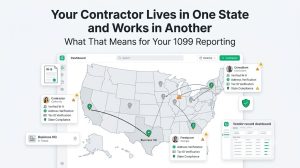
Hiring contractors across state lines has become routine for many businesses.
A company in Texas may work with a designer in Georgia, a developer in California, and a consultant who regularly travels between states. While paying remote contractors may seem straightforward, the combination of contractor residency, work location, and state tax rules can create reporting obligations that many businesses do not expect.
For most businesses, the process starts the same way: collect a W-9, pay invoices throughout the year, and issue a Form 1099-NEC when required.
The challenge is that a contractor’s mailing address does not always tell the full story.
When a contractor lives and works in the same state, reporting is usually straightforward.
However, remote work has made it increasingly common for contractors to:
As a result, businesses may need to consider more than just the address listed on a W-9.
Different states have different rules regarding income reporting, withholding requirements, and nonresident contractor payments. While federal reporting requirements remain consistent, state requirements can vary significantly.
Many businesses assume that a contractor’s mailing address determines all tax reporting obligations.
In reality, state tax agencies may consider additional factors.
Depending on the state and the nature of the work, reporting requirements may be influenced by:
Because state tax rules vary, businesses working with multi-state contractors should understand that a contractor relationship can potentially involve more than one state’s reporting framework.
Some states require businesses to do more than issue a federal Form 1099-NEC.
In certain situations, businesses may also have state-level filing or withholding obligations related to payments made to nonresident contractors.
The specific rules, thresholds, exemptions, and filing requirements differ from state to state and may change over time.
For businesses that regularly work with contractors across state lines, it is important to understand the requirements of the states involved and seek professional guidance when needed.
The key takeaway is simple:
A federal Form 1099-NEC does not automatically satisfy every state-level requirement.
A W-9 typically captures:
What it does not capture is where the contractor actually performed services throughout the year.
This creates challenges when contractors:
If vendor records are not updated, businesses may discover problems during 1099 season when forms need to be prepared and delivered.
Common issues include:
Contractors who relocate during the year may require updated vendor information. Businesses should have a process for identifying when a new W-9 is needed and updating records accordingly.
Businesses that successfully manage multi-state contractors tend to follow a few consistent practices.
Every contractor should submit a completed W-9 before receiving payment.
A standardized onboarding process helps ensure vendor records are complete from the start.
Vendor information should not be collected once and forgotten.
Businesses should periodically review contractor records and request updated information when significant changes occur.
Address validation helps reduce reporting errors and improves the accuracy of year-end tax documents.
Maintaining current address information becomes especially important when contractors relocate during the year.
Accurate recordkeeping makes it easier to prepare 1099s, review vendor information, and respond to reporting requirements.
Secure, centralized storage also reduces the risk of relying on outdated information scattered across email inboxes and spreadsheets.
Waiting until January to review contractor information often creates unnecessary problems.
Periodic vendor audits throughout the year help identify missing information, outdated addresses, and incomplete records before reporting deadlines arrive.
Working with multi-state contractors is now a normal part of doing business.
While businesses cannot control every state tax rule that may apply to a contractor relationship, they can control the quality of the information they collect and maintain.
Accurate W-9 records, current addresses, and regular vendor record reviews help businesses prepare for 1099 reporting and reduce the likelihood of last-minute surprises during filing season.
The goal is not to predict every possible state requirement.
The goal is to ensure that when reporting obligations arise, your business is working from complete, accurate, and up-to-date contractor information.
Not always, but businesses should review contractor records whenever a contractor changes their address or business information. Keeping W-9 records current helps ensure accurate 1099 reporting and vendor documentation.
A contractor’s address is important for tax reporting, but it may not be the only factor. Depending on the situation, businesses may also need to consider where services were performed and whether state-specific reporting requirements apply.
Yes. Remote work and travel make it common for contractors to perform services in more than one state during a tax year. Businesses should maintain accurate contractor records and review reporting requirements when multiple states are involved.
An outdated contractor address can lead to reporting errors, returned mail, and difficulties delivering tax forms. Regularly updating vendor records helps ensure information remains accurate throughout the year.
Businesses should generally collect a completed Form W-9 before issuing payment. The form provides the contractor’s legal name, taxpayer identification number (TIN), tax classification, and mailing address.
Many businesses review contractor records at least annually. However, records should also be updated whenever a contractor changes their address, legal name, entity type, or tax information.