Physical Address
5206 Hwy 5 N Suite 100, Bryant, AR, United States, Arkansas
Physical Address
5206 Hwy 5 N Suite 100, Bryant, AR, United States, Arkansas

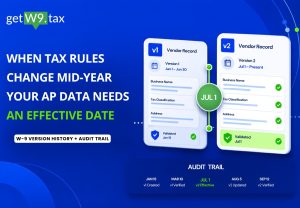
The 2026 mileage adjustment offers a practical lesson for W-9 audit trails: updating the latest value is not the same as controlling a change.
The IRS’s mid-year 2026 mileage-rate adjustment has nothing to do with Form W-9. That is exactly why it is useful as a control-design example for accounts payable teams. When a tax rule or vendor record changes during the year, can your system show which approved value was used, when it applied and who reviewed the change?
A spreadsheet with one current value cannot answer those questions. Neither can a shared folder that contains several PDFs named “final.” For cleaner 1099 preparation, AP teams benefit from effective dates, controlled version history and a usable W-9 audit trail. These are internal controls, not separate IRS Form W-9 requirements.
The core principle: Never confuse the latest approved value with the complete record. A current vendor profile shows the latest information on file; a W-9 audit trail shows what information the business relied on when a payment or filing decision was made.
IRS Announcement 2026-11 increased the optional standard mileage rate for business use to 76 cents per mile for deductible expenses paid or incurred on or after July 1, 2026. The earlier 2026 rate of 72.5 cents continues to apply before July 1. The medical and certain moving rate also changed from 20.5 cents to 23.5 cents per mile. View the IRS announcement.
The operational issue is not the rate itself. It is the effective date. If an expense system stores only one “2026 mileage rate,” updating that field to 76 cents can cause staff to apply the new rate to January through June mileage. Leaving the old rate in place creates the opposite problem for the second half of the year.
A controlled expense system should store both values, the date range for each, the source of the change and evidence that the configuration was reviewed. Vendor tax records benefit from the same discipline. This is AP control design, not a claim that the IRS mandates an effective-date field on Form W-9.
A W-9 supplies the requester with information used for tax reporting, including the payee’s name and taxpayer identification number. The form can also include a business name, federal tax classification, address and exemption codes. Those fields do not remain static forever.
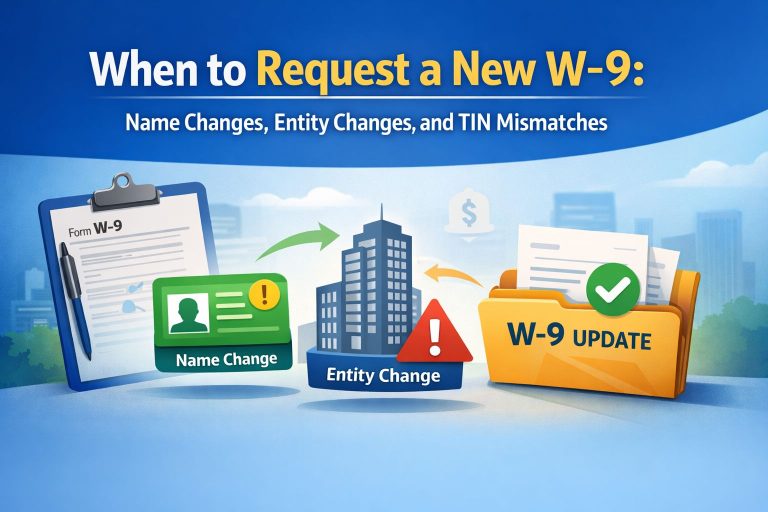
The IRS instructions state that a payee must furnish a new Form W-9 if the name or TIN for the account changes. A business may also request an updated form when other material details change or when the existing record appears unreliable, subject to its tax advisor’s guidance and internal policy. See the current IRS Form W-9 and instructions.
The weak workflow is to open the vendor master, type over the old value and replace the old PDF with the new one. That leaves the team unable to reconstruct which name, TIN or classification was on file when earlier payment and reporting decisions were made.
The stronger workflow keeps the approved current record easy to use while preserving restricted historical evidence. A recommended audit trail may show when the updated W-9 was requested and received, why the change was made, who reviewed it and whether downstream accounting records were updated.
| Field | Control purpose |
| Version ID | Distinguishes the approved record from prior versions. |
| Received date | Shows when the supporting W-9 entered the workflow. |
| Effective date | When supported, records when approved data should apply; Form W-9 itself does not contain this field. |
| Change reason | Explains whether the update involved name, TIN, entity, address or another field. |
| Source evidence | Links the change to the restricted W-9 or authorized documentation. |
| Reviewer | Identifies who approved the update and when. |
| Downstream status | Confirms whether accounting, payment and 1099 records were synchronized. |
| Access class | Keeps sensitive TIN evidence restricted to authorized users. |
Implementation note: Form W-9 has no effective-date field. Record an effective date only when it is supported by the payee or other authoritative documentation. Keep signature, received and approval dates separate, mask TIN references in broadly accessible logs and store completed W-9s in a restricted system.
The IRS permits electronic W-9 submissions. Under the requester instructions, an electronic system generally must ensure that the information received is what the payee sent; document user access that results in submission; make reasonably certain that the submitter is the person identified on the form or an authorized agent; provide the same information as the paper form; supply a hard copy if the IRS requests one; and capture an electronic signature under penalties of perjury when a signature is required. Read the IRS requester instructions.
That is an audit trail, not a digital filing cabinet. A PDF sitting in cloud storage may be electronic, but it does not automatically prove who submitted it, when it was received, which record replaced it or whether the change reached every downstream system.
For covered nonemployee-service payments made in 2026, the IRS information-return guide lists $2,000 as the Form 1099-NEC reporting threshold. The nominal deadline is January 31 for both the IRS and recipient. Because January 31, 2027 falls on a Sunday, the deadline for reporting 2026 payments moves to Monday, February 1, 2027 under the next-business-day rule. Review the 2026 IRS information-return instructions.
That threshold is a filing rule, not a vendor-onboarding strategy. A vendor below the threshold today may cross it later. Payment types can change. Waiting until December to request a W-9 compresses collection, review and corrections into the busiest part of the cycle.
Backup withholding is related, but the threshold still matters. For the relevant Section 6041 payments, the $2,000 threshold also applies to backup withholding in 2026, so annual payments below that amount generally do not require backup withholding under these rules. Once payments are reportable, 24% backup withholding may apply if the payee fails to furnish a TIN or the IRS notifies the payer that the name-TIN combination is incorrect. The practical response is still to collect and review vendor tax information during onboarding because payment totals can later cross the threshold.
The IRS and Security Summit’s 2026 summer campaign for tax professionals highlights phishing, security plans, multifactor authentication and rapid breach reporting. Although the campaign is not directed specifically at AP departments, the same security lessons are relevant wherever W-9 data is stored. For AP teams, the practical implication is simple: a recordkeeping process is not adequately controlled if unauthorized people can access or alter sensitive vendor data. Read the IRS Security Summit announcement.
A useful review therefore checks both dimensions: Is the vendor record correct, and can the business show that access and changes were controlled?
GetW9 helps businesses move W-9 collection out of scattered inboxes and manual follow-up lists. Teams can send a secure request link, track completion, use automatic reminders and store the submitted PDF and vendor details in one account. QuickBooks Online integration can also reduce manual re-entry, while USPS address validation is available on the Giga plan.
The goal is not to collect one more PDF. GetW9 supports the collection and tracking layer; effective dates, review approval, retention and downstream controls remain part of the business’s broader AP process. Start a 7-day free trial at GetW9.tax.
Mid-year tax changes expose systems that were designed around annual assumptions. The July mileage adjustment is one example: one year can contain two valid rates, and the effective date determines which one applies.
Vendor data creates a similar version problem. A name, TIN, classification or address can change during the year. If AP simply overwrites the old value, the business loses the context needed to support earlier decisions. Because Form W-9 does not contain an effective-date field, the business must distinguish the latest approved information from historical evidence and separately document any supported effective date. Version history and controlled evidence turn a current vendor profile into a more defensible record; they are internal controls, not additional IRS form fields.
Does the July 2026 mileage-rate change affect Form W-9?
No. The mileage adjustment and Form W-9 are separate issues. The mileage change is used here as a recordkeeping example because it shows why effective dates matter when tax rules or data change during the year.
When should a business request a new W-9?
The IRS form instructions specifically say a payee must furnish a new W-9 if the name or TIN for the account changes. Businesses may also adopt policies for requesting updates after other material changes or when a record appears unreliable. Confirm the policy with your tax advisor.
Can a W-9 be completed electronically?
Yes. IRS requester instructions allow electronic submission when the system generally meets requirements related to information integrity, submitter authentication, access documentation, paper-form content, hard-copy availability to the IRS and electronic signatures when required.
Should AP wait until payments reach $2,000 before collecting a W-9?
No. The IRS lists $2,000 as the 2026 Form 1099-NEC reporting threshold for covered nonemployee-service payments, and the same threshold applies to the relevant backup-withholding rules. Annual payments below that amount generally are not reportable payments requiring backup withholding under these rules. Operationally, however, collecting during onboarding remains the cleaner workflow because payment totals can grow and incorrect vendor data takes time to correct.
Should an old W-9 be deleted when a new one arrives?
Do not treat replacement as automatic deletion. Keep the approved current record easy to identify while following your organization’s retention, privacy and access-control policy for prior versions. Ask your CPA or legal advisor to confirm the required retention approach for your circumstances.
General information only. This article is not tax, legal or cybersecurity advice. Businesses should confirm reporting, withholding, retention and security requirements with qualified advisors.
Secure W-9 Storage and Access Control for Vendor Records
IRS Announcement 2026-11 – Optional Standard Mileage Rates
IRS Form W-9 and current developments
IRS Instructions for the Requester of Form W-9
IRS Guide to Information Returns
IRS and Security Summit 2026 summer campaign
IRS Publication 1099 (2026) – Reporting Thresholds and Due Dates
IRS Publication 334 – 2026 Reporting and Backup-Withholding Threshold