Physical Address
5206 Hwy 5 N Suite 100, Bryant, AR, United States, Arkansas
Physical Address
5206 Hwy 5 N Suite 100, Bryant, AR, United States, Arkansas
⚠️ Legislative Status Note
The One Big Beautiful Bill Act (OBBBA) was signed into law in 2025. The $2,000 1099-NEC threshold discussed in this article is now in effect for the 2026 tax year.
The One Big Beautiful Bill Act raised the federal 1099-NEC reporting threshold from $600 to $2,000 and the conclusion spreading fast through AP teams is this: we can collect fewer W-9s now.
That conclusion is wrong, and acting on it creates real compliance risk.
This post explains exactly what changed, what didn’t, and what your team needs to do before you adjust any part of your vendor onboarding workflow. If you’re responsible for contractor payments or year-end 1099 preparation, this is the nuance that matters most in 2026.
Before we get into what changed, here is the practical upshot for your team because this is the decision most AP leaders are trying to make:
Under prior law, businesses were required to file a Form 1099-NEC for any nonemployee freelancer, independent contractor, or self-employed vendor paid $600 or more in a calendar year. That $600 threshold had been in place for decades.
The OBBBA raises that threshold to $2,000 for 1099-NEC reporting. This applies to the 2026 tax year, meaning businesses are no longer required to file a 1099-NEC for contractors paid between $600 and $1,999 assuming all other conditions are met.
For a business with 50 freelancers earning between $800 and $1,500 per year, that could mean 50 fewer 1099-NEC filings come January. That is a genuine operational benefit. But it is a benefit that applies at year-end filing not at the point of vendor onboarding.
The threshold change affects 1099-NEC filing obligations. It does not change when a business is required to collect a W-9.
There is no IRS rule that ties W-9 collection to a dollar threshold. The W-9 is not a filing it is a data-collection instrument. Its purpose is to capture the vendor’s legal name, taxpayer identification number (TIN), and entity classification so that, when a filing obligation arises, you have the information you need.
The practical risk: if you stop collecting W-9s for vendors under $2,000, and that vendor’s payments later exceed the threshold through a scope expansion or a second engagement you will not have a W-9 on file when you need one. IRS rules then require you to begin backup withholding at 24% immediately on all future payments.
📌 Key Distinction
The $2,000 1099-NEC threshold 2026 change determines when you must file. Your W-9 collection policy determines whether you can file and whether you’re protected from backup withholding liability. These are separate obligations governed by separate rules.
You onboard a freelance designer in January for a $1,200 project. No W-9 collected because payments are under the $2,000 threshold. In June, you bring them back for a $900 follow-on project. Total payments: $2,100. You now have a 1099-NEC filing obligation and no W-9 on file. You must begin backup withholding at 24% on all future payments until they provide one.
Even when payments stay under $2,000, having a W-9 on file protects you if the IRS later sends a CP2100 notice flagging a TIN mismatch. Without a completed W-9, you have no documentation that you requested correct tax information a key factor in demonstrating good-faith compliance and avoiding the $60–$340 per-incident penalty for missing or incorrect information returns (IRS 2026 inflation-adjusted figures).
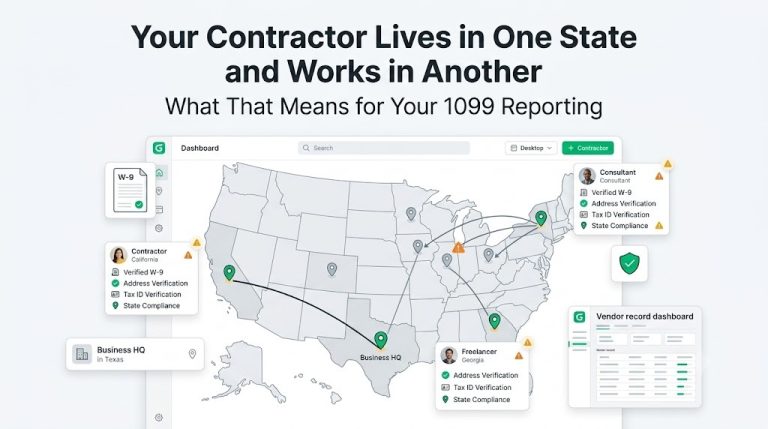
The OBBBA raises the federal 1099-NEC threshold. It does not touch state-level reporting requirements. Many states maintain thresholds at or below the prior $600 federal floor, meaning federal relief may not reduce your state filing obligations at all. Always confirm state-specific rules with your tax advisor.
| Area | Before OBBBA | After OBBBA |
| 1099-NEC filing threshold | $600 | $2,000 : CHANGED |
| W-9 collection requirement | No threshold collect before payment | No threshold unchanged |
| Backup withholding rate | 24% | 24% unchanged |
| Penalty for missing/incorrect TIN (per incident) | $50–$270 | $60–$340 (IRS 2026 inflation adjustment, not OBBBA-driven) |
| State-level thresholds | Vary by state (many at $600) | Vary by state unchanged at federal level |
No. The $2,000 threshold affects your 1099-NEC filing obligation at year-end not your W-9 collection requirement. There is no IRS dollar threshold for W-9 collection. Best practice is to collect before the first payment to every vendor, regardless of expected payment size.
The One Big Beautiful Bill Act threshold change is effective for the 2026 tax year. That means it applies to payments made on or after January 1, 2026, and affects the 1099-NEC forms that businesses will file in January 2027.
Under the new threshold, you are not required to file a 1099-NEC for payments under $2,000 at the federal level. However, you are still required to have attempted to collect a W-9 to protect yourself from backup withholding liability. If the contractor’s total payments later exceed $2,000, you will need the W-9 to file and without it, you must begin withholding at 24%.
The $2,000 threshold increase under the OBBBA specifically applies to 1099-NEC reporting for nonemployee compensation. The 1099-MISC and 1099-K have separate threshold rules and are not directly affected by this particular change.
Now that the OBBBA is law, the 1099-NEC threshold 2026 change will reduce year-end filing volume for businesses with large contractor rosters. That is a real operational benefit and worth planning for.
But the W-9 collection process should not change. The threshold governs filing; your W-9 policy governs readiness, protection, and backup withholding compliance. Conflating the two is one of the most common AP mistakes we see in the wake of new legislation.
The right question for 2026 is not “can we collect fewer W-9s?” It’s “how do we make W-9 collection so frictionless that it never creates a delay regardless of what the filing threshold does next?”
See how getW9 automates W-9 collection at the point of vendor onboarding
getW9 triggers a W-9 request the moment a new vendor is added before any invoice is approved. Every request is logged, timestamped, and stored with a full audit trail.
→ Start your free trial no filing subscription required