Physical Address
5206 Hwy 5 N Suite 100, Bryant, AR, United States, Arkansas
Physical Address
5206 Hwy 5 N Suite 100, Bryant, AR, United States, Arkansas

If you manage vendor payments, the IRS just changed something that may affect hundreds of records in your system right now.
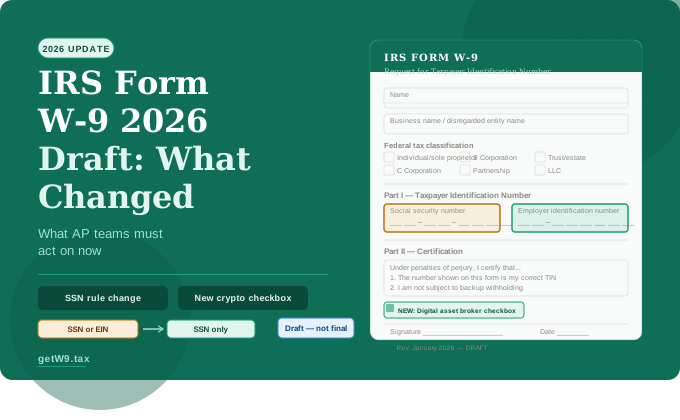
In September 2025, the IRS released a draft revision of Form W-9 dated January 2026 the first significant update since the March 2024 revision, and only the second in two years. For most AP teams, the day-to-day collection process hasn’t changed dramatically. But two specific updates matter: one that affects every sole proprietor and single-member LLC vendor you work with, and one that touches digital asset brokers.
This post covers exactly what changed, what it means for your vendor records, and the specific actions AP teams should take now, before the final form is released and the clock starts on compliance.
| ⚠ Important |
| Important: As of April 2026, the revised Form W-9 (Rev. January 2026) remains in draft status and has not been formally finalised by the IRS. Do not use the draft form for official submissions. W-9s you have already collected remain valid and do not need to be replaced. However, you should begin auditing which of your sole proprietor vendors submitted an EIN rather than an SSN because once the final form is released, those records will need to be refreshed. Monitor IRS.gov for the final release. |
Form W-9 officially “Request for Taxpayer Identification Number and Certification” is the form your vendors fill out to give you their legal name, tax classification, and taxpayer ID (TIN). You use it to prepare 1099s at year-end and to determine whether backup withholding applies.
Unlike most IRS forms, W-9 updates happen infrequently. The 2024 revision was the first in years. The 2026 draft arrives less than two years later, signalling that the IRS is moving quickly to align the form with its expanding digital asset reporting framework and to close a TIN compliance gap that has been generating B-notices for years.
The draft was published to the IRS draft forms portal in September 2025 with the date “Rev. January 2026.” Draft instructions were released in February 2026. Neither has been finalised, but the direction of the changes is clear and actionable.
This is the change that will affect the most AP teams, and it’s the one most likely to require action on existing vendor records.
Under the March 2024 revision of Form W-9 the version most vendors are currently submitting sole proprietors with an Employer Identification Number (EIN) had a choice. The form’s instructions explicitly stated:
| “If you are a sole proprietor and you have an EIN, you may enter either your SSN or EIN.” Form W-9, March 2024 revision (Part I instructions) |
Many sole proprietors especially those who operate under a DBA or who opened a business bank account obtained an EIN at some point. Under the 2024 rules, they could legitimately submit that EIN on their W-9.
The draft W-9 removes that flexibility entirely. The new language in Part I reads:
| “Do not report the employer identification number (EIN) of a sole proprietorship or disregarded entity.” Draft Form W-9, Rev. January 2026 (Part I instructions) |
Sole proprietors must now provide their Social Security Number (SSN) or, if applicable, their Individual Taxpayer Identification Number (ITIN). There is no longer an option to submit an EIN instead.
When a sole proprietor submits an EIN on their W-9 instead of their SSN, the name and TIN combination on their 1099 often doesn’t match IRS records because the IRS ties 1099 income to individuals via SSN, not EIN. This mismatch is one of the primary drivers of CP2100 B-notices, which require payers to start backup withholding at 24% until the issue is resolved.
By requiring sole proprietors to use their SSN, the IRS is closing that gap and reducing the volume of TIN mismatches before they become notices.
The 2026 draft also explicitly addresses single-member LLCs treated as disregarded entities a category that has long been a source of confusion.
A single-member LLC that is disregarded for federal tax purposes is treated as if it doesn’t exist separately from its owner. The draft instructs that the owner’s TIN not the LLC’s EIN must appear on the W-9. If the direct owner is also a disregarded entity, the rule cascades up to the first non-disregarded owner.
In practice, this means a freelance designer who operates as “Studio Name LLC” (taxed as a disregarded entity) should be submitting their personal SSN on their W-9 not the LLC’s EIN. Many are not doing this.
| ℹ Key Point |
| The March 2024 form already recommended this for disregarded entities, but the language was easily overlooked. The 2026 draft makes it unambiguous: the EIN of a disregarded entity must not appear in Part I. This is not a new requirement for most vendors it’s a clarification that will generate mismatches if ignored. |
Part II of the 2026 draft W-9 adds a new certification checkbox specifically for U.S. digital asset brokers. It reads:
| “I am exempt from information reporting as a U.S. digital asset broker within the meaning of Regulations section 1.6045-1(g)(4)(i)(A)(1) (other than a registered investment adviser). I claim exempt status under Regulations section 1.6045-1(c)(3)(i)(B)(12).” Draft Form W-9, Rev. January 2026 (Part II Certification) |
Alongside this, the draft adds a new exempt payee Code 14: a payee in a digital asset transaction that is exempt from backup withholding under IRS Notice 2025-33 through calendar year 2026.
The IRS is rolling out Form 1099-DA for digital asset transactions, requiring crypto exchanges, custodial brokers, and similar platforms to report gross proceeds and cost basis. The new W-9 checkbox allows one U.S. digital asset broker to certify to another that it qualifies as an exempt recipient preventing unnecessary backup withholding between broker entities.
The IRS has issued transitional relief (Notice 2025-33) providing that backup withholding on digital asset sales is not required in 2025 or 2026, giving platforms time to build out their TIN collection systems.
If your vendor base does not include cryptocurrency exchanges, digital wallet providers, or similar platforms, this change has no practical effect on your current workflows.
However, there is one operational implication that affects everyone: because the 2026 draft adds a new certification item to Part II, any organisation using a substitute W-9 form embedded in onboarding software or a vendor portal will need to update that form to include the new certification language even if the digital asset checkbox won’t apply to their vendors. Using an outdated substitute form after the final version is released could create compliance issues.
Before acting on the above, it’s worth being clear about what the 2026 draft does not change:
| Item | Status in 2026 Draft |
| Previously collected W-9s | Remain valid. Do not need to be replaced across the board. |
| Backup withholding rate | Unchanged at 24%. |
| Form structure (Lines 1–7, Part I, Part II) | Largely unchanged. New checkbox added to Part II; existing certification items unchanged. |
| Collection obligation | Unchanged. Collect before first payment; retain for at least 4 years. |
| Corporations, S-corps, and LLCs taxed as corporations | Unchanged. Use EIN. The SSN-only rule applies only to sole proprietors and disregarded entities. |
| W-9 retention period | Unchanged. The IRS recommends at least 4 years from the last tax year a payment was made. |
The final form has not been released. Once it is, organisations must begin using it immediately unlike the W-8 series, the IRS does not provide a grace period for adopting a revised W-9.
Here is exactly what to do in the window between now and the final release:
Run a filter in your accounting system or vendor tracker for vendors classified as sole proprietors or single-member LLCs. Identify which of those vendors submitted an EIN rather than an SSN on their W-9. These are the records that will need to be refreshed once the final form is published.
The draft form should not be used for official submissions. Sending vendors a new W-9 request now before the final form is released creates unnecessary friction. Instead, flag the records internally and prepare your re-collection workflow for when the final form drops.
If your onboarding system uses a custom or embedded W-9 form, make sure your team knows it will need to be updated once the final version is released. The new digital asset broker certification (Part II, Item 5) must appear on any substitute W-9, even if it’s not applicable to your vendors.
You can use the IRS TIN Matching Program to validate the name and TIN combination for vendors before filing 1099s. If you have sole proprietors on file with an EIN, running TIN matching now will tell you which ones are already causing a mismatch and which are at risk of triggering a CP2100 notice.
When the final W-9 (Rev. January 2026) moves from the IRS draft forms portal to the official forms page, the clock starts. You will need to begin collecting it from new vendors immediately, and begin re-soliciting updated forms from sole proprietor vendors whose EIN-based W-9s are now non-compliant.
| ✓ Action Required |
| One practical step to take this week: export your vendor list, filter for sole proprietors and single-member LLCs, and identify which ones used an EIN in Part I of their W-9. Flagging these records now means you’re ready to act the moment the IRS finalises the form. |
The IRS hasn’t specified exactly how it will treat 1099 filings that report a sole proprietor with an EIN after the final form is released. However, the consequences of a TIN mismatch are well established:
The cleanest way to avoid all of this is to catch the EIN/SSN mismatch at the point of W-9 collection before a 1099 is filed. That’s significantly less disruptive than correcting it after a B-notice has arrived.
When the IRS finalises the 2026 W-9, getW9.tax will update immediately. Vendors completing their W-9 through the platform will always see the current, compliant version of the form not an outdated substitute.
In the meantime, getW9.tax gives AP teams the tools to run the audit described above:
No. As of April 2026, the revised Form W-9 (Rev. January 2026) remains in draft status on the IRS draft forms portal. Do not use the draft for official W-9 submissions. The March 2024 version remains the currently valid form. Monitor IRS.gov for the final release.
No. W-9s already on file remain valid and do not need to be replaced across the board. However, once the final form is released, you will need to recollect from sole proprietor vendors who submitted an EIN rather than an SSN — because that information will no longer be compliant.
Yes — for now. The 2024 version of Form W-9 (the currently valid form) still allows sole proprietors to enter either their SSN or EIN. The SSN-only requirement is part of the 2026 draft. Once the final form is released, sole proprietors must provide their SSN.
Yes. Single-member LLCs that are disregarded entities for federal tax purposes must provide the owner’s TIN on their W-9 — not the LLC’s EIN. This was already the expectation under prior guidance, but the 2026 draft makes the language explicit and unambiguous.
Only U.S. digital asset brokers — such as cryptocurrency exchanges, custodial wallet providers, and similar platforms — will use the new Part II checkbox to certify exempt status. If your vendor base doesn’t include these entities, the checkbox has no practical impact on your collection process. However, if you use a substitute W-9 form, you will need to add the new certification language regardless.
The IRS has not published a timeline. Draft forms can take weeks or months to finalise. The best approach is to monitor the IRS forms page (irs.gov/forms-pubs/about-form-w-9) and to prepare your re-collection workflow now so you can move quickly once the final form is published.
The 2026 W-9 draft introduces two material changes: sole proprietors can no longer submit an EIN in place of their SSN, and digital asset brokers get a new certification mechanism in Part II.
Neither requires immediate action on vendor W-9s the final form hasn’t been released. But AP teams that begin auditing which sole proprietor vendors are on file with an EIN, and prepare their re-collection workflow now, will have a significant head start over those who wait until the final form lands.
In the meantime, the current March 2024 Form W-9 remains valid. Keep collecting it from new vendors before their first payment. And watch IRS.gov closely.
| Start collecting compliant W-9s before the final form drops getW9.tax updates automatically when the IRS finalises the 2026 form. Your vendors always complete the current version and you always have the audit trail to prove it. → Start collecting vendor W-9s at getw9.tax |
This article is based on the following primary sources. It is general informational content and does not constitute tax or legal advice. Consult a qualified tax professional for guidance specific to your organisation.