Physical Address
5206 Hwy 5 N Suite 100, Bryant, AR, United States, Arkansas
Physical Address
5206 Hwy 5 N Suite 100, Bryant, AR, United States, Arkansas


A common assumption inside nonprofit finance teams is this:
“We’re tax-exempt, so we don’t need to deal with W-9s and 1099s.”
That sounds reasonable. It is also wrong.
Tax exemption does not remove your nonprofit’s information reporting responsibilities. If your nonprofit pays independent contractors, vendors, speakers, consultants, or attorneys, you may still need to collect Form W-9 and file the correct 1099 form at year-end.
And the rule works both ways.
If a grantor, foundation, government agency, or corporate partner pays your nonprofit, they may still ask your organization to provide a W-9. That does not always mean they will issue you a 1099. Sometimes they simply need your legal name, EIN, address, and exempt payee information for their records.
This guide covers both sides:
The main point is simple: tax-exempt does not mean reporting-exempt.
The IRS treats tax-exempt organizations as payers for information reporting purposes. IRS guidance says tax-exempt organizations may need to file required information returns when they pay nonemployees for services.
That means your 501(c)(3) status does not remove your responsibility to:
What 501(c)(3) status generally does is exempt your organization from federal income tax on income related to your exempt purpose. It does not give your nonprofit a free pass on contractor reporting.
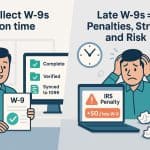
This is where many nonprofits create problems for themselves. They pay contractors throughout the year, skip W-9 collection, and then try to clean everything up in January. That is backwards.
The better process is to collect the W-9 before the first payment goes out.
Your nonprofit should request Form W-9 from U.S.-based vendors and independent contractors before paying them for services.
Common examples include:
The W-9 gives your nonprofit the information needed to decide whether a 1099 is required. It captures the vendor’s legal name, business name if different, federal tax classification, address, taxpayer identification number, and certification.
Do not wait until a vendor crosses the reporting threshold. A small vendor relationship can become a reportable relationship later in the year.
A contractor may start with a $900 project in March, then return for a $1,500 project in September. By year-end, the total is $2,400. If you did not collect the W-9 at onboarding, you now have to chase the vendor after the work is done.
That is a bad workflow.
For Form 1099-NEC, the IRS generally looks at whether the payment was made:
Nonprofits are included in the “trade or business” concept for information reporting purposes. IRS instructions for Forms 1099-MISC and 1099-NEC refer to payments made in the course of a trade or business, including payments by nonprofit organizations and government agencies.
Most payments to corporations are not reportable. But there are important exceptions, including attorney payments and medical or health care payments.
So the safe rule is this:
Collect the W-9 first. Decide the 1099 treatment after you know the vendor’s tax classification and payment type.
For 2026, the reporting threshold for many 1099-NEC payments and several 1099-MISC payment categories increased from $600 to $2,000. The IRS says the One Big Beautiful Bill Act increased the statutory threshold under section 6041(a) to $2,000 for payments made after December 31, 2025, with inflation adjustment beginning after 2026.
This means the first affected forms are generally the 2026 tax-year forms filed in early 2027.
But do not oversimplify this.
The $2,000 threshold does not mean every Form 1099-MISC box now has the same $2,000 rule. Some categories still have different thresholds. For example, the IRS 2026 Publication 1099 still lists gross proceeds paid to attorneys separately.
The 2026 threshold change does not change these three things:
Here is the practical rule:
Collect W-9s at vendor onboarding, not when the payment total becomes reportable.
Attorney payments are one of the most common reporting traps.
Payments to corporations are usually not reportable on Form 1099. But attorney payments are a major exception.
If your nonprofit pays an attorney or law firm for legal services, the payment may be reportable even if the law firm is incorporated. Attorney fees are generally reported on Form 1099-NEC when the reporting requirements are met.
There is also a separate rule for gross proceeds paid to attorneys. For example, if a payment is made to an attorney in connection with a legal settlement, it may be reported on Form 1099-MISC, Box 10. IRS instructions specifically discuss reporting gross proceeds paid to attorneys on Form 1099-MISC.
Do not treat all attorney payments the same.
A simple version:
This is a good area to confirm with your CPA before filing.
Collecting the W-9 is not enough. Someone has to check it.
Before filing the W-9 away, review these fields:
Line 1 should show the vendor’s legal name. For an individual, that usually means the person’s name. For an entity, it should match the legal name used for tax records.
Do not rely only on a DBA, brand name, or nickname.
Line 2 is for a business name, trade name, disregarded entity name, or DBA if different from Line 1.
This matters because the vendor’s classification helps determine whether a 1099 may be required.
For LLCs, the vendor must provide the correct tax classification. An LLC may be taxed as a disregarded entity, partnership, C corporation, or S corporation. Do not guess.
The address should be complete and usable for tax reporting. If possible, validate it against USPS standards.
The TIN may be an SSN or EIN, depending on the vendor type. The TIN should match the name on Line 1.
Name/TIN mismatches can trigger IRS notices later.
For normal vendor onboarding, treat an unsigned W-9 as incomplete. The IRS requester instructions say a valid Form W-9 or substitute form must contain the payee’s name and TIN and be signed and dated under penalties of perjury by the payee or an authorized person.
There are limited situations where certification rules can differ, but for a standard nonprofit vendor workflow, an unsigned W-9 should not be accepted as complete.
If a contractor refuses to provide a valid TIN, your nonprofit may be required to apply backup withholding.
The backup withholding rate is generally 24%. That means your nonprofit may need to withhold 24% from reportable payments and send that withholding to the IRS.
This is not something to fix after the fact. If the vendor refuses to provide the required information, the compliant path is not “pay them anyway and hope it works out.”
The cleaner process is simple:
No completed W-9, no first payment.
That does not need to be rude. It just needs to be part of your vendor onboarding policy.
Example wording:
“Before we can process payment, we need a completed Form W-9 for our vendor records. This helps us keep our year-end reporting accurate.”
That is clear. No drama. No chasing in January.
Now let’s flip the situation.
Sometimes your nonprofit is the payee. A foundation, government agency, corporate sponsor, or business partner may ask your nonprofit to send a completed W-9.
This often surprises nonprofit teams.
The instinct is to say:
“We’re tax-exempt. You don’t need a W-9.”
That response can delay payment.
A payer may request your W-9 because their accounts payable process requires a legal name, address, EIN, and tax classification for every payee. That does not always mean they will issue your nonprofit a 1099.
Your nonprofit may be asked for a W-9 when:
In many cases, the payer may not ultimately issue a 1099 to a 501(c)(3). But they may still need the W-9 for their records.
Do not turn a simple form request into a payment delay.
Here is the clean way to complete Form W-9 for most incorporated 501(c)(3) nonprofits.
Use the nonprofit’s legal name exactly as it appears in IRS records and on your Form 990 filings.
Do not use only an acronym, campaign name, or fundraising name.
Use this line only if your nonprofit operates under a registered DBA or trade name. Otherwise, leave it blank.
This is where many nonprofits get confused.
If your nonprofit is incorporated, the organization may check C Corporation because the W-9 is asking for federal tax classification structure, not whether the organization pays federal income tax like a taxable C corporation.
Some organizations may instead check Other and write something like:
“Nonprofit corporation exempt under section 501(c)(3)”
Do not check two conflicting classifications at the same time. Pick the treatment your CPA or tax advisor confirms is correct for your organization.
For many 501(c)(3) organizations, the exempt payee code is 1, which applies to an organization exempt from tax under section 501(a). IRS Form W-9 instructions list exempt payee code 1 for organizations exempt from tax under section 501(a).
The FATCA exemption code is usually left blank for a domestic nonprofit unless a specific situation requires it.
Use the nonprofit’s official mailing address.
Use the nonprofit’s EIN. Do not use an officer’s SSN.
An authorized officer should sign and date the form.
A donation is not the same as a payment for services.
If a donor gives your nonprofit a charitable contribution, your nonprofit generally does not need to collect a W-9 from the donor. The donor also may not need your W-9 just to make a donation.
But in real life, businesses sometimes ask for a W-9 before sending money because their AP team treats every outgoing payment the same way.
That does not always mean the payment is reportable. It may simply mean their system needs your nonprofit’s EIN and address before releasing funds.
The better response is not to argue.
You can say:
“We’re happy to provide our W-9 for your records. Please note that this payment is a charitable contribution, not a payment for services.”
That keeps the payment moving while protecting the distinction.
Do not lump all nonprofit revenue together.
A charitable contribution is different from a grant. A grant is different from a sponsorship. A sponsorship is different from a service contract.
Whether a payer reports a payment depends on the nature of the payment, the payer, the recipient’s classification, and the applicable reporting rules.
A safer way to think about it:
This is where nonprofit teams should not guess. If the payment is large or unusual, ask the CPA before assuming there is no reporting issue.
Run this once every quarter.
It should take less than an hour if your records are organized.
Look at every vendor paid in the last 90 days.
Separate contractors, consultants, attorneys, speakers, freelancers, and service vendors from payroll employees.
For every U.S.-based contractor or reportable vendor, confirm that a completed W-9 is stored in the vendor record.
If a W-9 is more than three years old, send a quick reconfirmation request.
This three-year review is an internal control, not a separate IRS expiration rule. A new W-9 is especially important when the vendor’s legal name, TIN, entity type, address, or exempt status changes.
Keep a signed W-9 for your own organization in a location your finance or AP team can access quickly.
If you use QuickBooks Online or another accounting system, make sure contractor vendors are marked correctly for 1099 tracking.
If the vendor is not marked correctly, the system may not include them when you prepare year-end forms.
This is the difference between a calm January and a messy one.
Yes, nonprofits should collect W-9s from U.S.-based contractors and certain vendors they pay for services. Tax-exempt status does not remove information reporting responsibilities.
A 501(c)(3) may need to file 1099 forms when it makes reportable payments to nonemployees or vendors. The form and threshold depend on the payment type and vendor classification.
No. The threshold affects when certain 1099 forms are required. It does not create a threshold for collecting W-9s. Collect the W-9 at onboarding.
Often, a payment to another incorporated 501(c)(3) may not result in a 1099 filing. But it can still be reasonable to request a W-9 for vendor setup and recordkeeping. Be especially careful with attorneys, medical or health care payments, and unusual payment types.
Usually, yes. If board members receive fees or honoraria as nonemployees, your nonprofit should collect a W-9 and evaluate whether Form 1099-NEC is required. Reimbursements under an accountable plan are different and are generally not treated the same way as compensation.
If a contractor refuses to provide a valid TIN, backup withholding may apply. The cleaner policy is to require a completed W-9 before the first payment is released.
Many incorporated nonprofits check “C Corporation” because Form W-9 asks for federal tax classification structure, not whether the organization is taxable like a regular C corporation. Some organizations may use “Other” with a written nonprofit exemption description. Confirm the preferred treatment with your CPA.
For many 501(c)(3) organizations, exempt payee code 1 applies because it covers organizations exempt from tax under section 501(a). IRS Form W-9 instructions list this code.
Charitable contributions are generally not treated like payments for services. But grants, sponsorships, reimbursements, and service contracts should be reviewed based on the actual payment arrangement.
Yes. Churches and religious organizations can have information reporting responsibilities when they pay contractors or vendors. A church paying a reportable contractor should collect a W-9 and evaluate whether a 1099 filing is required.
Tax exemption is not a shortcut around W-9 and 1099 rules.
If your nonprofit pays contractors, collect W-9s before the first payment. If your nonprofit receives payments from grantors, agencies, sponsors, or business partners, be ready to provide your own W-9 when asked.
The nonprofits that avoid January panic are not smarter. They just have a better workflow.
Collect the W-9 at onboarding.
Check the key fields.
Store it where finance can find it.
Review vendor records quarterly.
That is the system.
GetW9 helps nonprofits send secure W-9 requests, follow up automatically, validate addresses, and store signed W-9 PDFs with a submission history.
Start your trial at getW9.tax